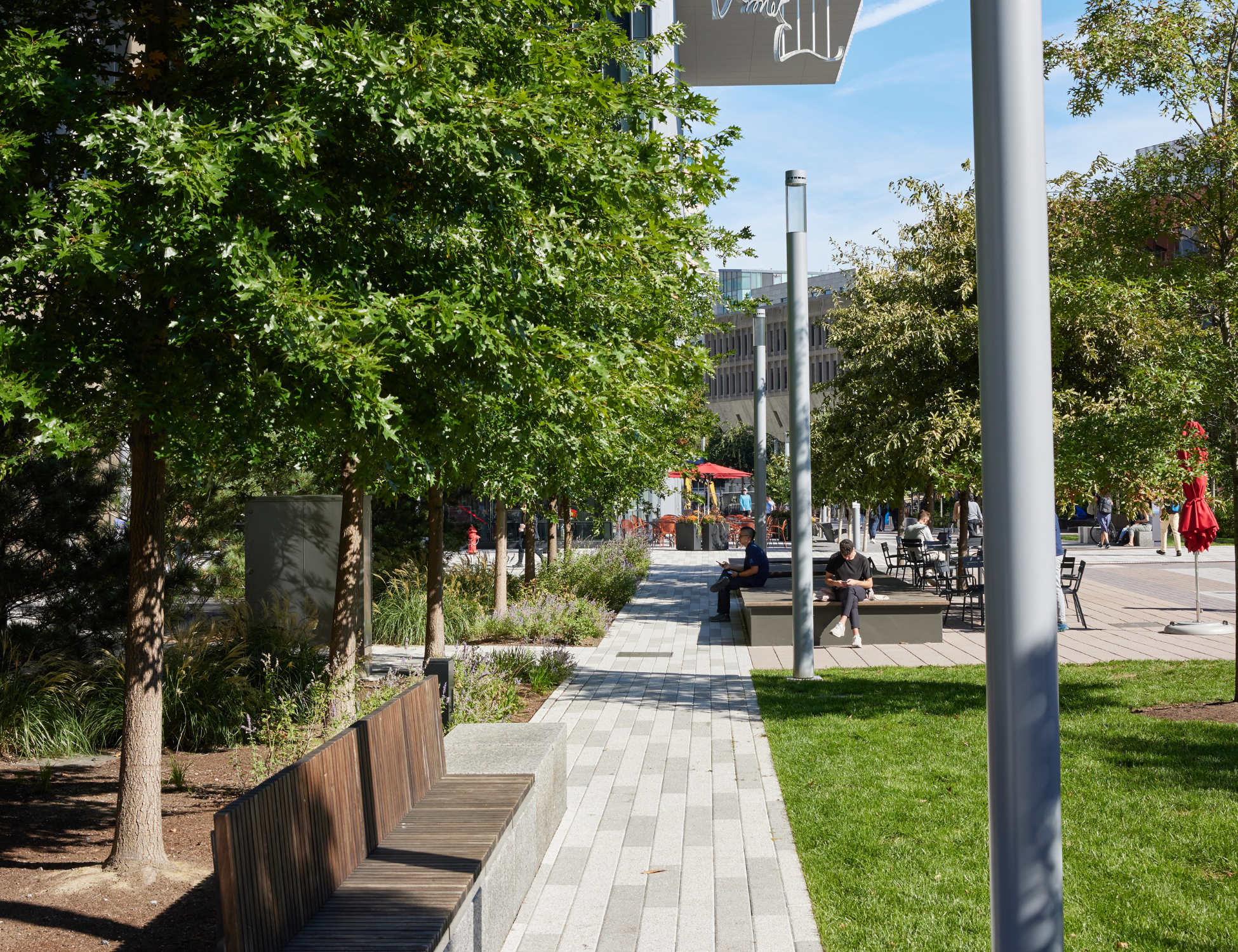

In the face of escalating climate challenges, the Massachusetts Institute of Technology (MIT) is actively engaged in climate action both on campus and at the local level. MIT’s most recent Climate Action Plan (CAP), Fast Forward: MIT’s Climate Action Plan for the Decade, announced in 2021, is at the heart of this work. It is a bold strategy that prioritizes climate resilience and ensures the institution leverages cutting-edge research to anticipate and tackle the impacts of severe climate events. Anchored by the MIT Climate Resiliency Dashboard, MIT’s climate resiliency efforts extend beyond its campus, setting a standard for collaborative, data-driven climate adaptation.
A Vision for a Resilient Future
MIT’s journey toward climate resilience began with building an acute awareness of vulnerabilities. In 2017, the absence of MIT-specific data in Cambridge’s FloodViewer highlighted a critical gap in understanding how potential flooding could impact the campus. This realization spurred the MIT Office of Sustainability (MITOS) to spearhead the development of a comprehensive tool: the MIT Climate Resiliency Dashboard.
Brian Goldberg, assistant director of MITOS, recalls the pivotal moment: “We recognized the need to communicate flood risks beyond just the meetings we held. With a campus community of more than 20,000, we needed a tool that was accessible, detailed, and rooted in science. The dashboard became our way of ensuring everyone—from students to faculty—could understand the challenges and opportunities of planning for a changing climate.”
The dashboard, developed with members of MIT’s Department of Facilities, Center for Global Change Science, Urban Risk Lab and other collaborators, provides a dynamic visualization of flood risks. This innovative tool integrates data from Cambridge, MIT’s host city, and MIT’s research to map potential flood depths and scenarios using best available science, supporting informed decision-making for infrastructure and campus planning.
Overcoming Challenges and Building Confidence
Creating a planning tool as intricate as the Climate Resiliency Dashboard presented significant challenges, particularly in navigating uncertainties inherent in climate modeling. “The biggest challenge,” Goldberg explains, “is creating certainty about an unpredictable future. Communicating what we know—and what we don’t know—in a way that’s grounded in science was critical. The dashboard is as much about providing clarity as it fosters trust in our models.”
This rigorous approach enabled MIT to refine its flood model while emphasizing transparency. By aligning with the City of Cambridge’s methodologies, MIT ensured its tools and strategies were scientifically robust and regionally consistent. This collaboration strengthened the dashboard’s credibility and underscored the importance of partnership in climate adaptation.
Expanding Focus: From Flooding to Extreme Heat
As the dashboard matured, MIT recognized the pressing need to address a growing climate threat: extreme heat. Urban microclimates, such as those on MIT’s campus, often experience intensified heat due to the urban heat island effect. Data from city and state sources revealed gaps in understanding localized temperature variations, prompting MIT to deploy sensors across campus.
“We realized weather stations like Logan Airport’s weren’t accurately capturing what was happening on campus,” Goldberg shares. “By collecting on-the-ground data, we could better understand microclimates and inform strategies to mitigate heat risks, like increasing shade and greenery.”
This expansion has informed heat preparedness actions, such as promoting MIT Cool Spots –publicly accessible and air conditioned spaces –, and fostered collaboration with Cambridge on open-source heat risk data collection methods. Together, MIT and the city are leading the way for broader efforts to address urban heat, demonstrating the potential of partnerships in tackling shared challenges.
Empowering a Resilient Community
MIT’s commitment to sustainability extends beyond data and tools; it actively involves its community. The MIT Porosity Hunt, a citizen science initiative, engaged students, faculty, and researchers in identifying vulnerabilities across campus buildings. Over 1,000 potential entry points for flood water—such as doors, windows, and vents—were mapped, significantly enhancing the accuracy of the flood model.
This hands-on project did more than improve technical outcomes. “The Porosity Hunt cultivated a culture of resilience,” Goldberg notes. “Students from diverse disciplines learned how climate considerations impact their fields, especially with older buildings not designed for today’s challenges. It’s about preparing future professionals to think critically about sustainability.”
By blending technical expertise with community engagement, MIT has empowered individuals to take ownership of climate resilience, embedding climate action into the institution’s ethos.
Scaling Solutions for a Global Impact
MIT’s campus has become a living lab for climate resilience, testing strategies that extend far beyond its boundaries. Insights from the Climate Resiliency Dashboard and initiatives like the Porosity Hunt are shared openly, offering valuable lessons for cities and institutions worldwide. As Goldberg emphasizes, “Climate impacts transcend individual campuses. We can create models that drive global progress by scaling solutions and collaborating regionally.”
Leading by Example
MIT’s climate resilience journey exemplifies the transformative power of collaboration, innovation, and community engagement. From the pioneering Climate Resiliency Dashboard to the grassroots Porosity Hunt, MIT has forged a path that others can follow. As institutions worldwide grapple with the realities of climate change, MIT’s approach offers a roadmap for adaptation and inspiration.
“Our hope is that others can learn from our efforts and leapfrog us so that collectively, we’re accelerating adaptation to a changing climate,” Goldberg notes. In Goldberg’s words, “Resilience is about scale and partnership. Climate impacts extend beyond individual campuses, so it’s critical to consider regional connections and engage with local towns, cities, and states. By working together, institutions can use their resources more efficiently and create models aligning with regional efforts. This approach strengthens climate resilience efforts and builds valuable partnerships that enhance long-term sustainability.”
Toward a Climate-Resilient Future
Looking ahead, MIT is committed to continually refining its Climate Resiliency Dashboard to address emerging threats. Future updates will incorporate advanced flood and heat models, integrate national data sources, and deepen partnerships with regional entities like Cambridge and Boston. “Over the next decade, we aim to create a comprehensive platform that enhances climate preparedness across our region,” Goldberg envisions. “By working together, we can better navigate the uncertainties of climate change.”