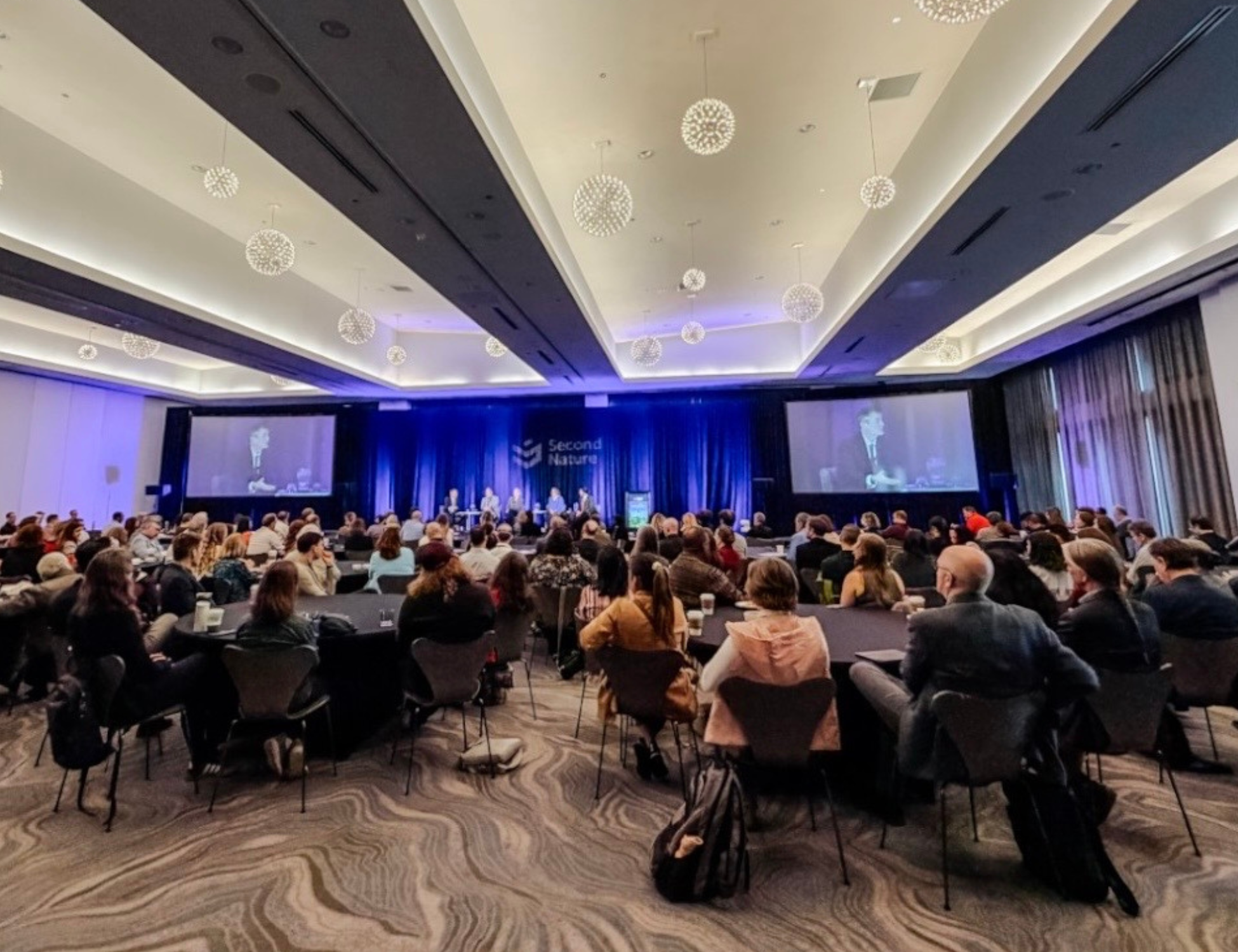
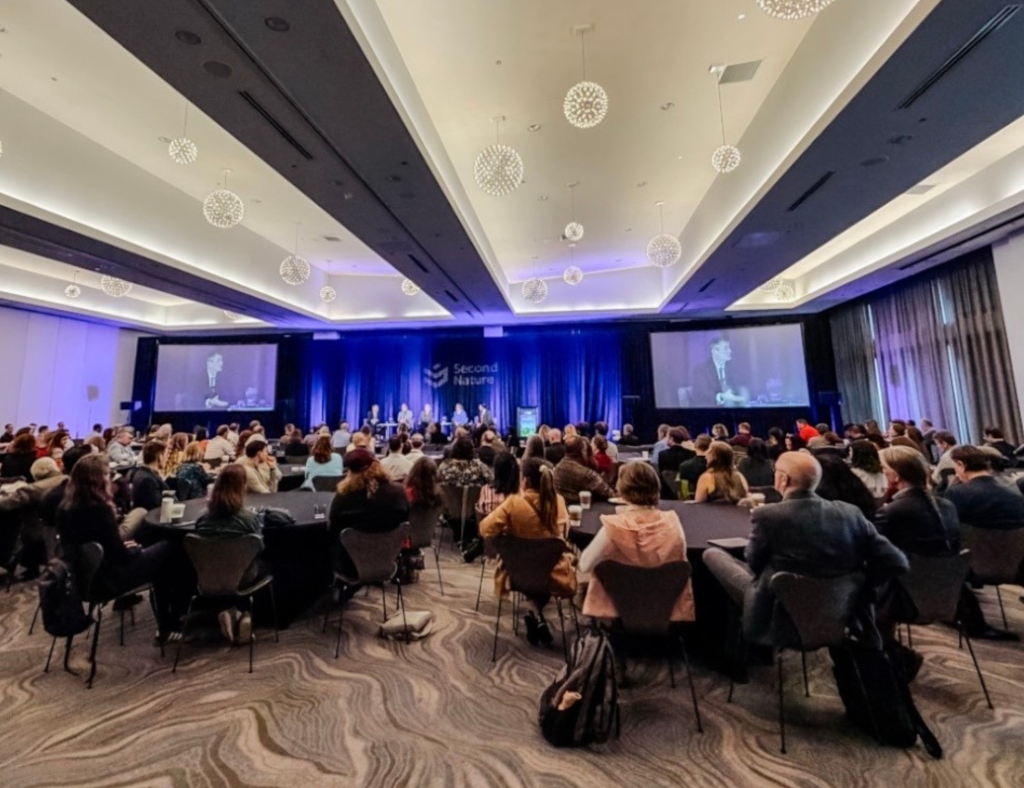
The 2026 Higher Education Climate Leadership Summit in Chicago felt less like a conference and more like a living ecosystem, one assembled on trust, urgency, and shared purpose. In hallways and the ballroom, at roundtables and over coffee, the conversations never stopped. This year’s gathering carried special weight, marking twenty years since the launch of the seminal Climate Leadership Commitments and providing a moment to pause, reflect, and recognize how far the sector has come.
When Second Nature convened campus leaders two decades ago, climate action often lived at the margins of institutions, championed by a few dedicated individuals. While still constrained by limited resources, climate action in higher education is much more prevalent today because of the Climate Leadership Network. What began as the world’s largest and longest-standing voluntary carbon commitment has helped establish campus sustainability professionals as necessary changemakers.

Collective Action Is the Catalyst
The Summit reaffirmed what we knew, but needed to feel: higher education remains one of the most powerful drivers of climate solutions in our society. In the opening remarks for the Summit, Second Nature’s President Tim Carter acknowledged the headwinds facing the sector, including political pressure, cultural pushback, and uncertainty about funding, policy, and the pace of change. Yet he reminded attendees that headwinds only slow us down when we’re coasting. At takeoff, they create lift. They force momentum. Throughout the two days that followed, speakers and participants returned to the same reframing: even in this moment of turbulence, using disruption as an opportunity is the path forward for higher education.
Throughout the conference, a common truth surfaced: no institution can do this work alone. Climate action does not scale through isolation. Change happens when we share resources rather than compete for them, when knowledge is exchanged freely across campus types and disciplines, and when lessons learned in one place become a starting point for progress elsewhere. The Summit became a proving ground for that belief, showing what happens when community colleges, research universities, rural campuses, and Minority Serving Institutions are not just present, but aligned.
One of the Summit’s most powerful themes was that diversity, across geographies, institution types, roles, and lived experiences, is not a box to check but the engine of progress. The full breadth of institutions came together, shaped by wide-ranging perspectives and experiences. Students shared spaces with climate leaders, sustainability professionals exchanged ideas with presidents, and community voices stood alongside researchers and policymakers. This was not about offering a symbolic seat at the table but about ensuring all voices have the power to shape decisions, influence outcomes, and drive meaningful change together.
Voices Across Campus
Students profoundly reminded us why this work matters. Their stories were raw, hopeful, and urgent, rooted in lived experience, climate anxiety, and an unshakeable belief that systems change when those in power are willing to listen to youth leaders and act together. Faculty and staff echoed that call, naming the barriers posed by siloed infrastructure and sharing concrete strategies to break them down. Presidents reflected on responsibility, not just to their institutions, but to democracy, to their communities, and to the students they serve, both now and in the future.
This spirit of collective action was evident not just in who was present, but also in the varied conversations at the Summit. Sessions explored campus decarbonization, climate justice, community partnerships, workforce development, Indigenous knowledge systems, artificial intelligence, and democratic engagement, highlighting the interconnectedness of this work.
In Indigenous Wisdom for Climate Action, speakers grounded climate solutions in relationships to land, culture, and ancestral knowledge, reminding participants that sustainability is inseparable from identity and justice. Accounting for Tech’s Emissions pushed institutions to confront the rapidly growing climate and public health impacts of artificial intelligence, calling for transparency, discernment, and collective pressure on industry. Unlocking Meaningful Community Engagement for Climate Action emphasized that trust, not transactions, is the foundation of lasting partnerships, and that climate solutions must be generated with communities, not prescribed to them. Together, these sessions illustrated the Summit’s core truth: there is no single pathway to climate leadership, only a shared commitment to learn from one another and act together.
The need for unified effort came into sharp focus through Unify for Climate, Second Nature’s call to action to align the sector’s strengths without erasing its differences. Through a new milestones program, updated guidance and programming, and additional transparency and accountability, Second Nature is signaling support for institutions at every stage of their climate action journey. Unification does not ask institutions to look the same or move at the same pace, but to share the commitment to lead on climate action, with our success defined not just by reduced emissions, but by trust built, capacity strengthened, and communities served.
From Momentum to Movement
The Summit closed with a feeling of momentum. Attendees reflected a renewed sense of clarity and collective resolve. In a time when it would be easier to retreat, higher education is choosing to advance, to collaborate, and lead.
Second Nature is committed to carrying the Summit’s momentum forward through Unify for Climate. By aligning with one another, while recognizing that alignment does not mean uniformity, we can collectively amplify student leadership, embrace the full breadth of institutions and communities, and champion climate action at local and national levels, turning today’s headwinds into shared momentum for a sustainable future.