

Authored by:
- Tim Carter, President, Second Nature
- Stephen M. Gavazzi, Director, CHRR at The Ohio State University
- Meredith Leigh, Climate Programs Senior Manager, Second Nature
Four years can feel like a lifetime in the conversation about climate. In 2021, CHRR at The Ohio State University partnered with Second Nature to track public perceptions of climate-related issues over time. Back then, when we first surveyed members of the American Population Panel about climate change, concern was high. When we returned to those same respondents in 2025, the shift was unmistakable: Americans are more worried than ever about the impact of climate change on themselves, their families, and their communities. And they increasingly expect colleges and universities to lead the way and take more action.
What the Data Tell Us
The longitudinal study began with 5,530 respondents in 2021, and we followed up with 2,050 of them in 2025. The demographic profile skewed older (average age 57), predominantly white (82 percent), and urban (87 percent).
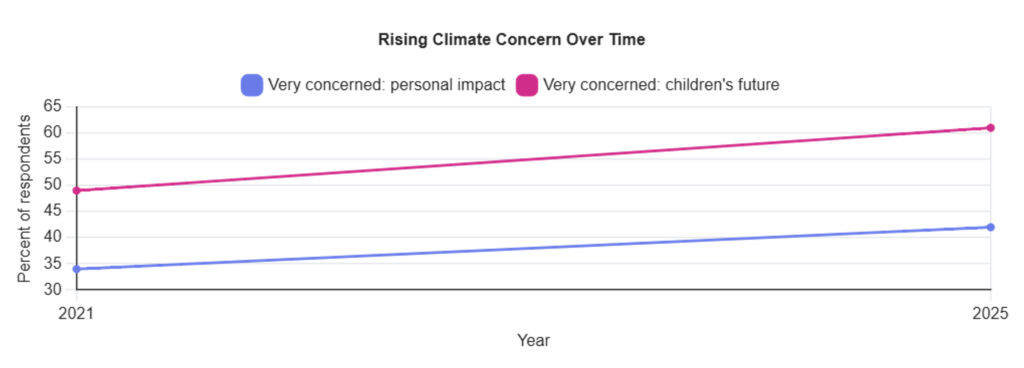
- Personal concern surged. In 2021, 34percent of respondents said they were “very concerned” about climate change’s impact on their own lives. By 2025, that number rose to 42 percent. Concern for children’s futures saw an even sharper increase, with “very concerned” responses rising from 49 percent to 61percent among those with children.
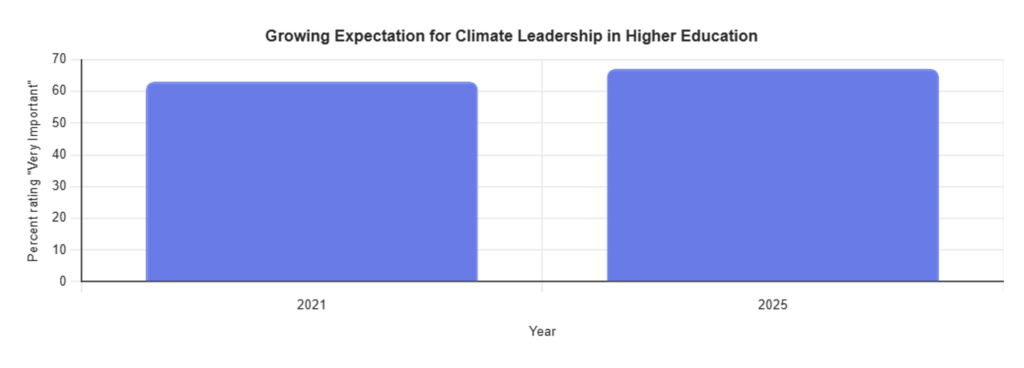
- Higher education matters more. When asked how important climate-related work should be to colleges and universities, the percentage answering “very important” increased significantly. In 2021, 63 percent of respondents rated climate-related work by colleges and universities as “very important.” By 2025, that number had increased to 67 percent, reflecting a growing expectation that higher education plays a central role in climate solutions.
- But perceived current action lags behind belief in what is possible. Across both waves, roughly 31 percent of respondents consistently said that colleges and universities are “doing too little” when it comes to providing information to the public about climate action. While some movement occurred toward “doing the right amount,” the perception of insufficient action remained dominant.
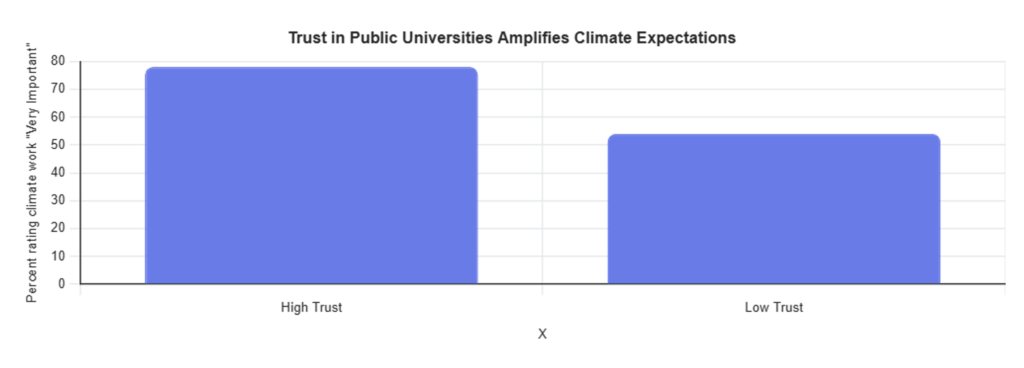
- Trust increases expectations. In 2025, 44 percent of respondents reported “high trust” in their state’s public universities. Among them, 78 percent rated climate-related work by universities as “very important,” compared to just 54 percent among those with “low trust.” This suggests that trust in institutions amplifies expectations for climate leadership.
Why This Matters
Universities are uniquely positioned to address climate change—not only through operational decarbonization, research, and innovation, but also through education, public engagement, and policy influence. Yet, the public perception that we are “doing too little” should be a wake-up call. If higher education wants to maintain credibility and relevance, climate leadership must expand beyond on-campus sustainability plans and carbon audits buried in annual reports.
This is about widespread visibility and public impact. It’s about making climate work central to the mission, not peripheral. It’s about ensuring that the public sees colleges and universities as trusted partners in solving the most pressing environmental challenge of our time.
What Higher Education Should Do
1. Lead visibly… (words optional). Communicate climate initiatives in ways that resonate beyond campus walls. Transparency builds trust. Each community will have different priorities, as others have shown, so talk about climate in whatever is most resonant. Moms and dads like clean air for their kids. Farmers like healthy soil. Anglers like clean water.
2. Educate broadly. Integrate climate literacy across disciplines—not just in environmental science courses.
3. Engage communities. Partner with local governments, schools, and organizations to translate research into action.
4. Advocate responsibly. Use institutional voice to support evidence-based climate policy.
As the impacts of climate change on the public increase, they are looking to higher education for answers. Our data show that Americans believe universities should be at the forefront of these efforts. The question is whether we will rise to meet that expectation—or continue to be seen as “doing too little.”
Fortunately, there are promising models to build on. The Climate Leadership Network, led by Second Nature, aligns the climate action of hundreds of colleges and universities across the US. In recent years, Second Nature has implemented a strategy to recognize and support institutional leaders across various institution types and roles, driving more meaningful climate solutions in their communities. A few examples include:
- Southern Oregon University is building energy and community resilience into the curriculum through the Institute for Applied Sustainability. The University is piloting a scholarship program for non-STEM students to participate in the resilience curriculum, access energy dashboards, and explore the co-benefits of the campus, which includes a powered-by-solar disaster shelter and other resilience resource available to the community at large.
- Carleton College students worked with the Northfield Community Action Center to recover food that would otherwise be wasted from area groceries and dining facilities and expand a community food shelf for underserved families. Food that cannot be donated is composted or fed to pigs. Alongside the initiative, students researched the methane avoided by diverting the food from the landfill and quantified the carbon benefit to help Carleton College offset its carbon footprint. The project provides funding to support the Northfield Community Action Center in continuing its mission, while educating students and advancing campus carbon neutrality goals.
In summary, the public is increasingly concerned about climate change and views higher ed as a vital component of the solution. Our data show that trust in universities strengthens expectations for climate leadership, and that perception of institutional action still lags public hope. Fortunately, initiatives like Second Nature’s Climate Leadership Network offer tangible examples of how colleges and universities can lead in ways that are visible, community-centered, and impactful. By scaling these efforts and communicating them clearly, higher education can meet the moment—and help shape a more resilient future.