Get the latest on climate action:

The Presidents’ Climate Leadership Commitments provide frameworks to advance campus climate action. While each institution determines their own goals and actions, there are key steps needed to fulfill the intention of the commitments. Please use this Implementation Handbook to review the requirements and find links to in-depth resources for implementation.

Resources

IMPLEMENTATION STEPS

Please use this section of the Implementation Handbook to review the timeline and requirements. More in-depth resources for implementation can be found on the Implementation Resources page and Resources section of Second Nature’s website.

Climate Commitment

1. Organize

Implementation Structure

Create internal institutional structures to guide the development and implementation of the Plan

Key Steps

  1. Within one month, appoint an Implementation Liaison
  2. Provide contact information of the appointed Implementation Liaison to [email protected]. The Liaison will then receive a welcome email detailing next steps and allowing them to complete onboarding for your institution into the Climate Leadership Network.
  3. Within two months, complete the Onboarding Process outlined in the Second Nature welcome email, which includes, but is not limited to: 
    • Scheduling an onboarding meeting with Second Nature staff
    • Providing branding resources to your institution’s communications office
    • Providing your institution’s branding information to Second Nature
    • Ensure that dues have been paid and that Second Nature has the appropriate contacts to conduct the annual dues process 
    • Optional: Share contact information for any secondary contacts (contacts that receive the same communications as ILs)
  4. Within two months, create or strengthen internal structures (task force, committee, etc.)
  5. Continuous:
    • Keep contacts up to date during times of transition by notifying Second Nature via email [email protected] of any changes to contacts.
    • Browse Climate Leadership Network Membership Opportunities & Resources to find your group, community of practice, or other support resource to support your institution’s Commitment. Share this resource with your campus community to ensure your full institution is benefiting from your Second Nature membership.  

Campus-Community Structure

Actively support a joint campus-community task force (or equivalent) to ensure alignment of the Plan with community goals and to facilitate joint action.

Key Steps​

  1. Create and support a joint campus-community structure
  2. Within one year, complete the Campus-Community Structure Report and provide Campus-Community Contacts by emailing [email protected]
  3. Continuous:
    • Maintain community relationships, evolve structure as needed
    • Report any updates as structure changes

2. Assess

Greenhouse Gas Inventory

Conducting and publicly disclosing GHG inventories is part of the Climate Commitment.

Within one year of the implementation start date, and we recommend every year thereafter, complete a greenhouse gas inventory.

Key Steps

  1. Within one year, complete a baseline Greenhouse Gas Inventory

Initial Campus-Community Resilience Assessment

Conducting an initial campus-community Resilience Assessment is part of the Climate Commitment and the Resilience Commitment.

Within two years of the implementation start date, lead and complete an initial campus-community Resilience Assessment, including initial indicators and current vulnerability.

Key Steps

  1. Within two years after signing, complete an Initial campus-community Resilience Assessment

3. Climate Action Plan

Develop a comprehensive Climate Action Plan. Within three years of the implementation start date, complete the Plan (also reflecting joint community-campus components), which will include: 1) Target date for achieving carbon neutrality and/or decarbonization targets as soon as possible, 2) Target date by which defined thresholds of resilience will be met, 3) Target dates for decarbonization including stationary combustion and renewable energy, 4) Mechanisms and indicators for tracking progress (including those that cut across campus-community boundaries), 5) Interim target dates for meeting decarbonization and resilience milestones, 6) Identify Climate Action Milestones to pursue (optional), 7) Actions to make climate action and resilience a part of the curriculum and other educational experiences for all students, and 8) Actions to expand research in climate action and resilience.

Key Steps

  1. Using campus assessment data, determine target dates and thresholds
  2. Use existing local/state/federal/international targets to guide Plan development
  3. Chart opportunities and processes to integrate your climate action strategies with operational, curricular, research, and community engagement objectives
  4. Identify funding mechanisms to achieve Plan objectives
  5. Develop processes for engaging the campus community in climate action prioritization and planning
  6. Report the Climate Action Plan to Second Nature

Climate Action Milestones: Second Nature recommends aiming for Climate Action Milestones. Submit your progress, get recognized, and share your progress with other campuses to accelerate learning.

Online Guide Resource

4. Measure Progress

Within one year of the implementation start date, and every year thereafter, complete an annual progress update.

Key Steps

  1. Submit the second Annual Progress Update
  2. Update GHG inventory data as necessary
  3. Update resilience progress as necessary

5. Review

Review and update your Climate Action Plan. Second Nature recommends updating your Climate Action Plan every five years or so. You may want to update or integrate campus master plans, strategic plans, or decarbonization plans at about the five year interval.

Key Steps

  1. Review the existing Climate Action Plan and determine if new targets and actions are needed.
  2. Create a new report or amend a current report with new actions.

Carbon Commitment

1. Organize

Implementation Structure

Create internal institutional structures to guide the development and implementation of the Plan.

Key Steps

  1. Within one month, appoint an Implementation Liaison (IL)

  2. Provide contact information of the appointed Implementation Liaison to [email protected]. The Liaison will then receive a welcome email detailing next steps and allowing them to complete onboarding for your institution into the Climate Leadership Network.

  3. Within two months, complete the Onboarding Process outlined in the Second Nature welcome email, which includes, but is not limited to:
    1. Scheduling an onboarding meeting with Second Nature staff
    2. Providing branding resources to your institution’s communications office
    3. Providing your institution’s branding information to Second Nature
    4. Ensure that dues have been paid and that Second Nature has the appropriate contacts to conduct the annual dues process 
    5. Optional: Share contact information for any secondary contacts (contacts that receive the same communications as ILs)
  4. Within two months, create or strengthen internal structures (task force, committee, etc.)
    1. For Carbon Commitment signatories, see see Organizing for Action
  5. Continuous:
    1. Keep contacts up to date during times of transition by notifying Second Nature via email [email protected] of any changes to contacts.
    2. Browse Climate Leadership Network Membership Opportunities & Resources to find your group, community of practice, or other support resource to support your institution’s Commitment. Share this resource with your campus community to ensure your full institution is benefiting from your Second Nature membership.

2. Assess

Greenhouse Gas Inventory

Conducting and publicly disclosing GHG inventories is part of the Carbon Commitment.

Within one year of the implementation start date, and we recommend every year thereafter, complete an Annual Progress Update and make the Annual Progress Update (including greenhouse gas inventory), publicly available by submitting to Second Nature’s Public Reporting Module on SIMAP.

Key Steps

  1. Within one year, complete and submit a baseline greenhouse gas inventory

    2. Submit the first Annual Progress Update

3. Climate Action Plan

Develop a comprehensive Climate Action Plan. Within three years of the implementation start date, complete the Plan, which includes: 1) Target date for achieving carbon neutrality and/or decarbonization targets as soon as possible, 2) Interim target dates for meeting milestones that will lead to carbon neutrality, 3) Target dates for decarbonization (recommended), 4) Mechanisms and indicators for tracking progress (including those that cut across campus-community boundaries), 5) Actions to make climate action a part of the curriculum and other educational experiences for all students, and 6) Actions to expand research in climate action.

Key Steps

  1. Using campus assessment data, determine target dates and thresholds.
  2. Use existing local/state/federal/international targets to guide Plan development.
  3. Chart opportunities and processes to integrate your climate action strategies with operational, curricular, research, and community engagement objectives.
  4. Identify funding mechanisms to achieve Plan objectives.
  5. Develop processes for engaging the campus community in climate action prioritization and planning.
  6. Report the Climate Action Plan to Second Nature.

Climate Action Milestones: Second Nature recommends aiming for Climate Action Milestones. Submit your progress, get recognized, and share your progress with other campuses to accelerate learning.

4. Measure Progress

Within one year of the implementation start date, and every year thereafter, complete an annual progress update.

Key Steps

  • Submit the second Annual Progress Update
  • Update GHG inventory data as necessary

5. Review

Review and update your Climate Action Plan. Second Nature recommends updating your Climate Action Plan every five years or so. You may want to update or integrate campus master plans, strategic plans, or decarbonization plans at about the five year interval.

Key Steps

  1. Review the existing Climate Action Plan and determine if new targets and actions are needed
  2. Create a new report or amend a current report with new actions

Share progress and get recognized through Climate Action Milestones, and help other campuses by sharing your progress.

If your institution is having trouble meeting its signatory commitment, reach out to Second Nature to discuss options

Resilience Commitment

1. Organize

Campus-Community Structure

Convene and actively support a joint campus-community resilience task force (or equivalent) facilitate joint action.

Key Steps

2. Access

Initial Campus-Community Resilience Assessment

Within two years of the implementation start date, lead and complete an initial campus-community Resilience Assessment, including initial indicators and current vulnerabilities.

Key Steps

3. Plan

Develop a Resilience Plan or integrated Resilience and Climate Action Plan. Within three years of the implementation start date, complete the Plan (also reflecting joint community-campus components), which may include: 1) Target date by which defined thresholds of resilience will be met, 2) Mechanisms and indicators for tracking progress (including those that cut across campus-community boundaries), 3) Actions to make climate action and resilience a part of the curriculum and other educational experiences for all students, 4) Actions to expand research in resilience and adaptation.

Key Steps

  1. Using campus and community assessment data, determine target dates and thresholds
  2. Use existing local/county/region/state/federal/international targets to guide Plan development
  3. Chart opportunities and processes to integrate your resilience strategies with operational, curricular, research, and community engagement objectives
  4. Identify funding mechanisms to achieve Plan objectives
  5. Develop processes for engaging the campus and local and regional community in resilience prioritization and planning
  6. Report your plan to Second Nature

4. Measure Progress

Submit an Annual Progress Update.

Key Steps

  1. Submit an Annual Progress Update to Second Nature.
  2. Develop resilience metrics to guide and gauge progress.

Climate Action Milestone: Resilience: Consider submitting your progress, getting recognized, and sharing your progress with other campuses to accelerate learning.

5. Review

Take stock on what has working well and what can be improved for future scenarios.

Implementation Support

Contact Second Nature

To schedule a phone call with Second Nature Staff, please call 617-722-0036 or email [email protected]. We can provide:

  • One-on-one support on any stage of Commitment implementation or reporting needs
  • Connections to peers and other signatories for support
  • Virtual presentations to climate change/sustainability committees or senior leadership group
  • In-person presentations and facilitation, as mutual travel budgets allow
  • Help reviewing existing network resources and materials, and navigating external opportunities
  • Network engagement support to help you maximize your membership in the Climate Leadership Network

Reporting Deadline

All reports are due annually and can be submitted between January 1 and May 1 of each year.

If your institution is having trouble meeting its signatory commitment, reach out to Second Nature to discuss options.

Annual Dues

Demonstrating the importance that the Presidents’ Climate Leadership Commitments play as a catalytic force on campuses, and reflecting the value of participating in a leading national network, signatories pay annual dues. Second Nature accounts for the size of the institution and the institutional expenses in setting the annual rates. Second Nature leverages philanthropic, corporate, and government revenue to further assist signatory institutions in their climate action work and keep dues as low as possible. Dues payments and honor society participation also make participation possible for institutions that have been historically disinvested and under-resourced.
Timeline Images

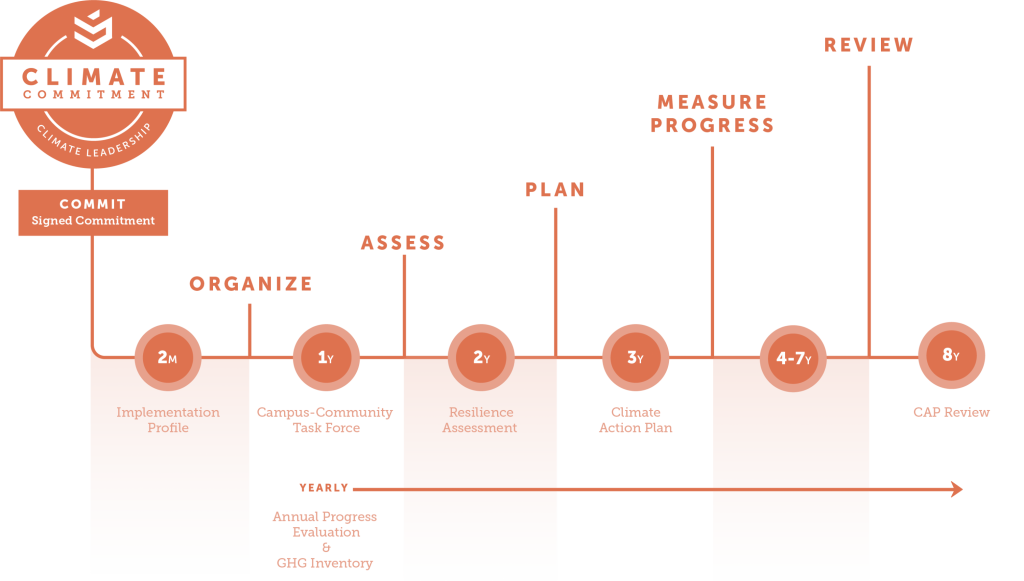
Climate Commitment

Timeline: 2 Months organize, 1 year assess, 2 years plan, 3 years measure progress, 4-7 years review

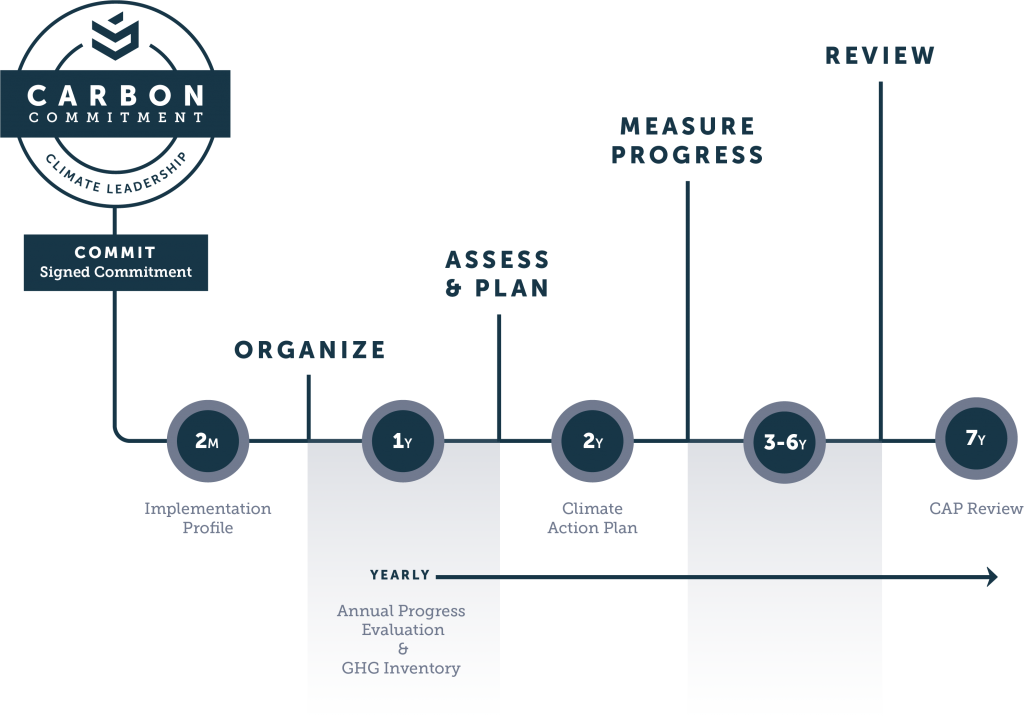
Carbon Commitment

Timeline: 2 months Organize, 1 year Assess and Plan, 2 years Measure Progress, 3-6 years review

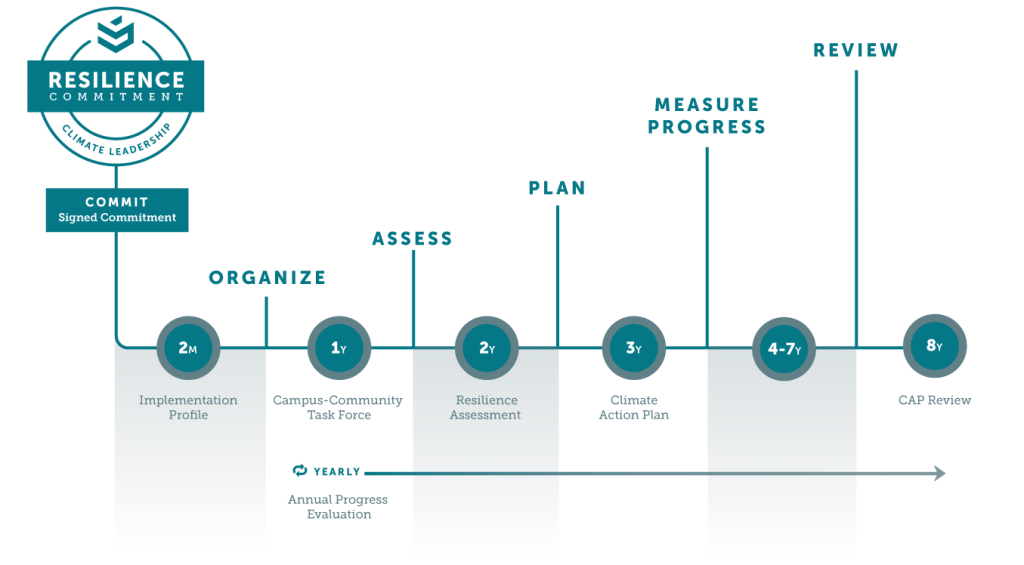
Resilience Commitment

timeline: 2 months organize, 1 year assess, 2 years plan, 3 years measure progress, 4-7 years review

Stay Connected to Climate Action

Sign up for the Implementer, Second Nature’s monthly newsletter, for updates, network news, resources, and opportunities to engage in climate action across higher education.